For our blog’s next topic, I would like to focus on stereotypes, particularly southern stereotypes. Southern stereotypes are often portrayed in movies, television, commercials, etc. Southerners are constantly compared to northerners. Northerners are shown to be progressive, intelligent, face-paced, but arrogant and rude while southerners are shown to be hospitable, patriotic, friendly, but slow and unintelligent. In this video (also embedded below), Craig Considine directed a discussion about northern and southern stereotypes and typical views that Americans have of their countrymen. Starting at 1:15, a few people list some common stereotypes. One southerner described northerners as rude, rich, fast-paced, arrogant, and jerks. One northerner described southerners as civilized, but backwards, not intelligent, and poor. Another northerner says he thinks of rednecks when he thinks about the South. Below the first video is a slideshow of redneck images. Most of these images show comical contraptions or people doing very unintelligent things. People associate these images, however, with rednecks and the south.
What are some common stereotypes you associate with the South? Have you seen anything lately that portrayed the common stereotypes of the South? Do you think southern stereotypes still provide an accurate representation of the post-modern south? Is there still a difference between northerners and southerners now? Is the division less or more defined?
I also found an interesting blog post about stereotypes from southern blogger J D Murrah. In his blog post titled, “A Southern Primer: Truths, Untruths and Stereotypes,” Murrah writes about where some stereotypes come from and describes their origin or completely refutes them based on history, southern traits, and outlooks.
Sunday, February 28, 2010

Thursday, February 25, 2010
My Image of a Small Southern Town
When I think about a small southern town, I think about a bunch of close-knit houses and buildings. I think about a place where all the shops and markets are within a short walking distance from one’s home. I picture a small school, courthouse, and church around the corner. I picture neighbors gathering around for a nice chat. In a small southern town, I imagine everybody to know everybody else along with family histories and stories. When I think about a small southern town, I think about a sense of community and closeness with neighbors.
My image of a small southern town mostly comes from literature. In To Kill a Mockingbird, the fictional town of Maycomb, Alabama is a small town in which everybody is close and knows each other well. For example, when Miss Maudie’s house burns down, the people of the town gather and help save her possessions. There is also a part in the book when Scout explains to her teacher why a poor boy in the class would not accept the teacher’s money. The boy came from a family that would not take anything that they could not afford to pay back. Bastard out of Carolina also describes a small southern town. In Greenville, South Carolina, the people of the town are familiar with each other. The Boatwrights men have a famous reputation for being hostile, and everybody in the town knows about the Boatwright legacy. In a small southern town, the stories of each family are familiar to the people in the town.
I used to live in Hong Kong and New York. Neither place holds that good-natured feel of a small town. Both places were very populated and one would barely know his or her neighbor no matter how long he or she lived in an area. I now live in Lilburn, a suburb of Atlanta. I wouldn’t call Lilburn a small southern town either. However, there is a part of Lilburn called Old Town which still contains buildings from the 1930’s. There are also many antique and craft shop, and the homes in the area are old-fashioned. Old town still contains this small town feel of Lilburn that used to exist before it started growing and populating.

Antique and craft shops at Old Town, Lilburn
Descriptions from literature and the contrast of Old Town with the busy places where I used to live establish my image of a small southern town.
Small Southern Community
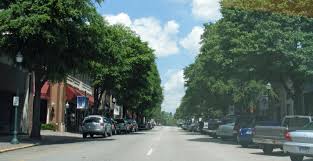
Mainstreet in the town Center of LaGrange, Ga
The idea of a small southern community is an image which is commonly shared between most southern people. It is an image influenced and ingrained via southern literature, media, and music. Specifically, it is most epitomized, in my opinion, by the small fictional town of Mayberry in the Andy Griffinth Show. Also, towns like Gentilly, which is meticulously described in gross detail in The Moviegoer also help perpetuate the idea of a small southern town. I myself came from small town in southern Georgia. LaGrange, Ga has an approximate population 26,000 which is fairly large for a typical southern town but in reality its layout is highly influenced by the conceptualized idea of what a southern community is thought to be. The town itself purposely promotes small business and actively limits the amount of commercialized chains from coming. This is all done to proactively retain the identity of a small southern town.
My question to you is what is your idea of a small southern town? What exactly makes it up – an image? A sense of community? And for those that don’t have much experience with life in a small town, it will be interesting to see what type of insight you offer. Also, enlighten us on the derivation of your knowledge of small town life so that we can see how and where from this image is portrayed.
Wednesday, February 24, 2010
On Racism
For starters, I would like to argue against the chart that Daniel posted. It does give some basic information regarding racial hate crimes, but the real trend there is behind population. The highly populated states like New York, California and Michigan all have more people. California and New York in particular have very large cities and many more people. California has nearly ten times the population of Alabama, and Michigan is pretty well populated as well. It has about the same number of people as Georgia. I do agree with you that calling the entire South racist is a ridiculous claim.
As someone who isn't from the South, I feel I can offer a different perspective on racism. People I know and I would often mention the subject, but it was always in some sort of jest. I didn't come to Tech expecting everyone to have racist beliefs. In fact, I expected rather the opposite. I am not one to judge before I truly get to know someone, so I held myself to not believing anything about the subject, save for the common stereotypes. Stereotypes are most often incorrect, and I know this quite well.
That said, I do agree that as a general population, we believe racism is gone. I know this is false. There are two incidents in particular which I remember, one vaguely and the other rather vividly. The first was the murder of Amadou Diallo. Diallo was an immigrant from Guinea who came to New York City in 1996, and was there for three years after. He wanted to become a student, and was working on the streets to try and make that happen. He was stopped for looking like a wanted criminal. He obviously wasn't this person. There were four officers who stopped him as he was entering his house. The officers thought he was ignoring their orders to stop, and when he reached into his jacket, they shot at him an incredible forty one times. It was determined that he was reaching for his wallet, and the officers were later acquitted for murder charges. I don't remember much of the incident, as I was still young, but I do remember that it sparked large debates about racial profiling and such. There was much debate on the issue, and I can look back on it and decide for myself that the entire issue was based around race. The second incident I mentioned was the trial and conviction of Eric Frimpong. There is a good article on it here: http://sports.espn.go.com/espn/news/story?id=4300383 (I know it's ESPN, but the facts are all good, even if it is clearly written with bias.) To put a long story short, Frimpong was charged with sexual assault on a weak case with little evidence, and more evidence suggesting that he did not do anything wrong than the other way around, yet was still sent to jail for six years. I remember this incident much better, and that the primary reason for his being sent to jail was the belief that he was a violent criminal, based on another "incident", which was literally just a statement. Again, racial profiling was present, but this time it was much less publicized. I believe this is because we are forgetting that racism does still exist in today's world. We have each provided certain incidents for or against the claim made below, but the bottom line is that these are often isolated incidents, and we have to look at the bigger picture.
As someone who isn't from the South, I feel I can offer a different perspective on racism. People I know and I would often mention the subject, but it was always in some sort of jest. I didn't come to Tech expecting everyone to have racist beliefs. In fact, I expected rather the opposite. I am not one to judge before I truly get to know someone, so I held myself to not believing anything about the subject, save for the common stereotypes. Stereotypes are most often incorrect, and I know this quite well.
That said, I do agree that as a general population, we believe racism is gone. I know this is false. There are two incidents in particular which I remember, one vaguely and the other rather vividly. The first was the murder of Amadou Diallo. Diallo was an immigrant from Guinea who came to New York City in 1996, and was there for three years after. He wanted to become a student, and was working on the streets to try and make that happen. He was stopped for looking like a wanted criminal. He obviously wasn't this person. There were four officers who stopped him as he was entering his house. The officers thought he was ignoring their orders to stop, and when he reached into his jacket, they shot at him an incredible forty one times. It was determined that he was reaching for his wallet, and the officers were later acquitted for murder charges. I don't remember much of the incident, as I was still young, but I do remember that it sparked large debates about racial profiling and such. There was much debate on the issue, and I can look back on it and decide for myself that the entire issue was based around race. The second incident I mentioned was the trial and conviction of Eric Frimpong. There is a good article on it here: http://sports.espn.go.com/espn/news/story?id=4300383 (I know it's ESPN, but the facts are all good, even if it is clearly written with bias.) To put a long story short, Frimpong was charged with sexual assault on a weak case with little evidence, and more evidence suggesting that he did not do anything wrong than the other way around, yet was still sent to jail for six years. I remember this incident much better, and that the primary reason for his being sent to jail was the belief that he was a violent criminal, based on another "incident", which was literally just a statement. Again, racial profiling was present, but this time it was much less publicized. I believe this is because we are forgetting that racism does still exist in today's world. We have each provided certain incidents for or against the claim made below, but the bottom line is that these are often isolated incidents, and we have to look at the bigger picture.
Tuesday, February 23, 2010
Racism has NOT been forgotten
In my previous blog I found an article on the Jena Jena
Now that was just a small demonstration of how people are taking racism seriously in this one place for that one case, but not only are people taking the racism problem seriously on the community level but also nationally and globally. I found one website that lists over 2000 organizations that deal with discrimination around the globe. The
Sunday, February 21, 2010
Racism in a Store
An Extension of Racism beyond the South
This video demonstrates that even when racism is prevalent the majority of people will not intervene. This not only eludes to the idea that people will turn a blind eye towards outward racism but people, even northerners, may not intend on even upholding the moral ground and intervening themselves. With this said, segregation and physical racism may not necessarily be as predominant as it has been in the past, but that the societal trend has moved away from progressively fighting racism. I believe this is true for two reasons, one because we have become complacent and feel as though racism has been almost entirely dissolved (not true in the least) and just apathy towards the subject either because we were so inundated with it before or because we have moved onto other problems to worry about (war, economy, etc.)
Thursday, February 18, 2010
 As used in my presentation, I will use this graph to indicate that the most hate crimes which are due to race occur in places other than the South. California, New York, and Michigan all have the most occurrences of hate crime in their state. While states like Georgia, and Alabama, have very little hate crime due to race.
 This is where I say that the Southern Identity can be misrepresented because of past events such as Slavery, Jim Crow laws, and other forms of racism. 50 years after racism is over, people still have the argument that the South is racist. While some people in the South might be racist, I think it is inaccurate to say that the WHOLE South is racist.
Subscribe to:
Posts (Atom)